
How LinkedIn helped me transition from NHS physio to solopreneur.
I joined LinkedIn in 2015. Within 24 hours, I deactivated it. I knew immediately that I didn’t need that in my life. With a blossoming NHS career happening, I didn’t feel it was necessary. Fast-forward to September 2022, and I’d rejoined.
I’d already been thinking of something new. I loved writing, but never thought I’d have the guts to do it for a living. Now, in my 5th decade on this earth, and having already changed careers in my 4th, I surely couldn’t do it all over again. This was now the lane I’d chosen, and I’d pressed the cruise control button. Life was just going by.
LinkedIn, so far, had just been something I’d signed up for. I had very few connections. I hadn’t posted. I hadn’t commented. I didn’t know what my business was going to look like. The thought of doing anything on it was petrifying!
‘I’ve no idea what I’m doing or what to talk about.’
‘What if I make a fool of myself?’
‘They’ll know I’m a physio, so my reputation is on the line.’
I had one friend on LinkedIn who was a teacher turned copywriter. By complete coincidence, I’d seen his post about #CopywritersUnite just hours after I’d quit my NHS job on 18th November 2022. This was a get-together, in my home city, that night. I had nothing to lose, so I went.
I slowly walked over to this bunch of strangers in the pub, head bowed, quietly asking if I could join them. I was asked to introduce myself.
‘Hi, my name is Andy Goldman. I quit my job today because I want to be a copywriter.’
‘WHOOP WHOOP!’ They all cheered.
This turned into a red-letter day in the history of my career, because 3 hours later, I had over 20 new LinkedIn connections, business cards, and a notebook full of ideas and advice.
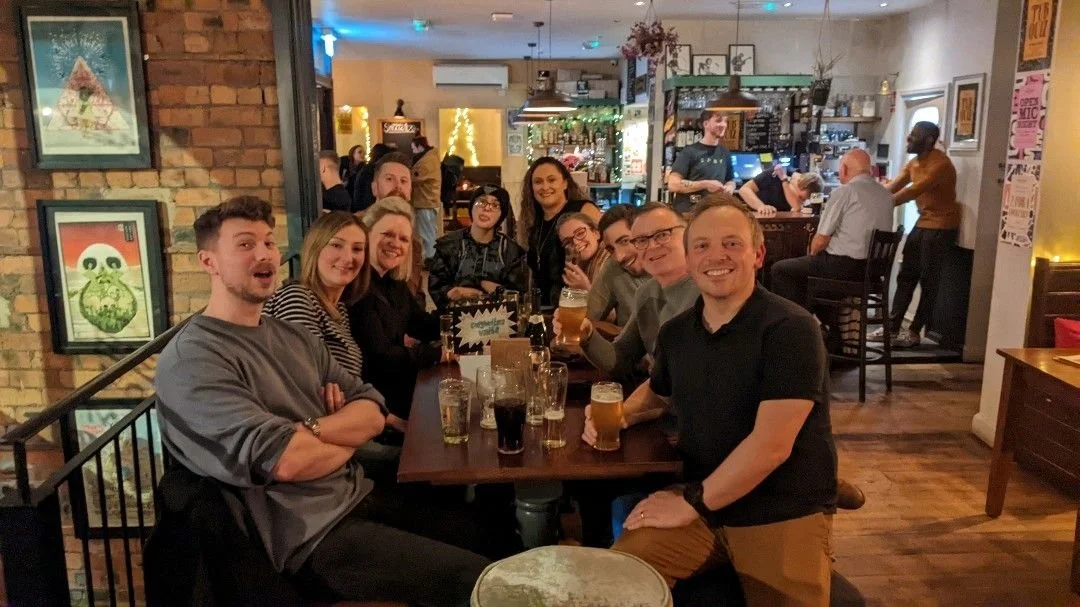
#CopywritersUnite on 18th November 2022
One quick scroll, one action taken, and my account was up and running with new people. What followed has been nothing short of remarkable. LinkedIn became my professional diary. Posting gave me practice in writing, and the comments served as feedback. I developed my own tone of voice and found new ways to express myself.
I began to learn who and what I wanted to be, which meant I was able to create a business out of it. Copywriting eventually transitioned to writing LinkedIn profiles and posts for clients in the healthcare industry. Which then became 1:1 training and workshops for allied health professionals.
I think back to the morning of 18th November 2022 and the inbox I woke up to. It was that inbox that tipped me over the edge and made me hand in my notice. Here’s how this morning went:
I got up at the same time as my wife and daughter and made their packed lunches for work and school. Once they’d left, I started brewing coffee. Steaming and black, with dark chocolate notes and a hint of caramel. I sat in my garden with pen and paper, not making a to-do list,but a list of ideas. I had nowhere I needed to be stuck in traffic on a commute for. I was already in the environment I needed to be present in.
I didn’t have a waiting list of 100 patients to think about. I didn’t have anyone call in sick. I didn’t have to put on a brave face to lead a team through the next crisis.
I’m not advocating handing in your notice today! Have some semblance of a plan. Mine was to keep my registration as a healthcare professional. This has enabled me to see patients privately, to keep my clinical skills up, and stay bang up-to-date with the audience my clients still serve.
I love LinkedIn for the 8200+ people it has brought into my life, the support I’ve received and have now been able to return, and the opportunity to be heard. No other social networking platform gives you that so quickly.
I want other allied health professionals to experience this, hence my pivot. I’ve found an area that’s so desperately needed in our industry, and I want to help my clients find their voice, grow their reputation, and achieve balance in life.

I got used to my new work life balance pretty quickly.
5 easy ways to get started and grow on LinkedIn.
LinkedIn has over a billion users. That sounds daunting enough. I wasn’t used to posting online all about me. Well, I might’ve posted all about a marathon I did, or how good my dinner was. On Facebook. So my mum, and my uncle in America could see. But to grow my reputation on a professional networking platform, with a business I hadn’t yet figured out? It still makes me shudder now. Then I received the best piece of advice I’ve ever been given about LinkedIn. And it didn’t even need to be related to healthcare. So here’s a strategy that can be used by anyone wanting to start being heard:
1. ‘Network, network, network!’
Engaging with content written by others became the easiest way to show up and create conversation. It occurred to me that creators who write posts, actually want the engagement! Who would’ve thought?!
When you add your piece to their post, it’s extremely likely that they’ll reply. Not only that, their connections will also see what you’ve written. It's an open platform for them to also join the conversation. Before you know it, you’re in a network.
2. Find your tribe.
Surrounding myself with people in the industry I wanted to be in the business of was a must. For me, that was writing and healthcare. In the beginning, I decided I wanted to be a copy and content writer; to write beautiful words for websites, email campaigns, and blogs. Bringing other copy and content writers into my network gave me the opportunity to learn the craft, and how to find clients. Connecting with those working in healthcare gave me the opportunity to showcase my expertise and authority in the field.
Through LinkedIn, I found a closed networking group to join, and it changed everything. Working on your own can be a lonely state of affairs, particularly after having worked face-to-face with people in the NHS for over 10 years. Pangs of imposter syndrome were hitting hard. But the networking group I chose to join enabled me to submit pieces of writing for feedback, gave me a safe space to talk about how my business was going, and the confidence to start posting more openly on LinkedIn.
3. Just start writing.
LinkedIn is the perfect platform to get writing practice. The analytics tell you how many times your post gets seen (an indication of how valuable your content is), number of likes and comments (see who has engaged with you), and number of times people have viewed your profile (if this goes up, you know your content is interesting and drawing them in).
Review your individual posts to learn what works and what doesn’t. LinkedIn lets you see how many impressions you get for each of the comments you leave. Comments can be just as valuable, if not more so, than the posts you create. Give value, ask questions, drive the conversation.
4. Create a profile that speaks all about... someone else.
The idea of posting and leaving comments is really to get the reader onto your LinkedIn profile. This is your landing page. The place where action is ultimately taken. The mistake people make, time and time again, is to tell the audience all about themselves. As harsh as this sounds, they don’t really care. They just want to know what’s in it for them. By now, you should have all the tools to understand your ideal customer profile (ICP). These are the people you want to attract and offer your services to. Show them how you provide the solution to their problem — an offer they just can’t ignore.
Start with the headline, banner, andabout sections. Be consistent and clear with your message across all three: who you serve, what you do for them, and how they can hire you. If you have clarity in what you do, your ICP will do, too.
5. Ask for endorsements and recommendations.
As I said earlier, talking about yourself isn’t easy. It feels cringe. Gives you the ick. I also said that your profile needs to be about your ICP, not you. They’re a selfish lot!
The way around this is to ask your customers to endorse your skills and write nice things about you in the recommendations section. It always sounds better coming from someone else anyway. If you’ve done a great job, they’ll go over the top when feeding back and tell everyone about it. Ask them to include how you solved their problem, and the results they had. You get the social proof and credibility, and build a reputation that tells your prospective ICP that you’re the person they need.
I’ll leave you with one of my favourite recommendations received on LinkedIn. It was one of my earliest since becoming a LinkedIn trainer for allied health professionals, and so satisfying for me to read:
‘Working with Andy was a brilliant experience. His approach is hugely supportive and encouraging, whilst imparting large amounts of highly insightful and practical knowledge at the same time. Most importantly, he gave me confidence to move forward and also to be myself in what was previously an intimidating space!’ - Jen Plagerson - Physiotherapist - AHP Coach.
Connect with me on LinkedIn to learn more about my services, and drop me a DM.